
Can you use Signal and still comply with record-keeping rules?
Published: October 7, 2026 · Updated: October 8, 2026
Here is the honest tension: Signal is designed to keep as little as possible, and some laws require businesses to keep everything. Disappearing messages delete chats on a timer; record-keeping rules in finance, healthcare, and other regulated industries demand that business messages be retained and producible for years. Signal has no server-side archive, no retention controls, and no admin override - so it cannot satisfy those duties on its own. This page explains what Signal stores, what it cannot do, and how regulated teams draw the line in practice. This is general information, not legal advice. If your industry has retention rules, talk to your counsel before deciding anything.
from Signal's official site — file hosted by Signal, not by us
The problem in plain words
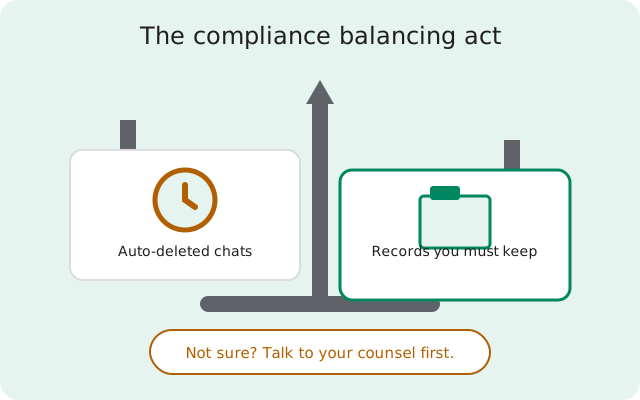
Signal's whole design philosophy is data minimization: keep almost nothing, know almost nothing, and let messages live on the devices of the people talking. That is why privacy-minded teams love it. It is also the exact opposite of what compliance regimes ask for. A financial firm may need to retain client communications for years and produce them on demand. A healthcare provider may need message logs for audits. A company in litigation may be under a legal duty to preserve relevant messages the moment a dispute is foreseeable.
These two designs cannot be reconciled inside one app, because Signal has no knob for it. There is no admin console where a compliance officer sets a seven-year retention policy. There is no central archive to search. There is no legal-hold button. The app that cannot keep your messages is the same app some businesses need to keep their messages. Once you see that clearly, the rest of this page is just working out the practical consequences.
The most common mistake is treating disappearing messages as a compliance feature. They are the opposite: a privacy feature that actively works against retention. Turning on auto-deletion to keep chats tidy is a reasonable personal choice. Turning it on across a regulated business, where the law says keep, is where companies get into real trouble. We say this bluntly because it is the single most misunderstood setting in business use of Signal.
What Signal stores - and what it does not
What the server keeps
To judge Signal against a retention duty, you need to know where messages live. The answer is: on the phones involved, and nowhere else that matters. When you send a message, Signal's servers hold it briefly for delivery - if the recipient is offline, it waits in a queue - and then it is gone from the server. There is no mailbox in the cloud, no admin panel where someone reads the archive, no backup you can download from a dashboard. The company is designed to have almost nothing to hand over, which is also why it has so little to give governments that ask.
What stays on the phones
What stays on devices is the full chat history, unless disappearing messages delete it. That history is readable by design on an unlocked phone, exportable in limited ways, and deletable by whoever holds the device. There is no central copy to fall back on and no way for an administrator to reach into an employee's phone and pull the records. For compliance purposes, this means the "system of record" for anything said in Signal is a handful of personal phones that walk out of the building every evening.
What a retention duty actually needs
Compare that with what a retention duty typically needs: messages captured at send time, stored immutably, searchable by a compliance team, producible on demand, held for a defined period. Signal provides none of that infrastructure. It is not a flaw in the app; it is the product. But it means Signal cannot be the place where regulated conversations happen. Full stop.
What disappearing messages actually do
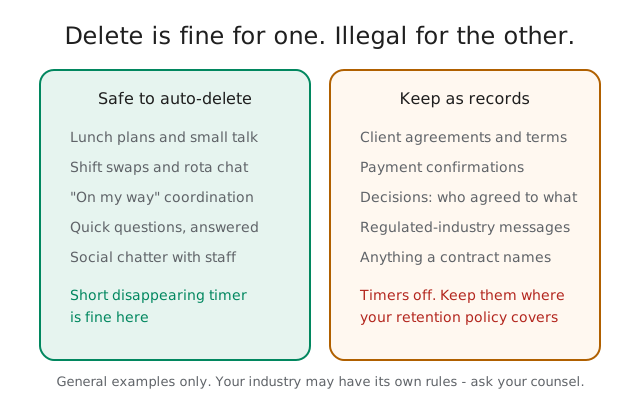
Disappearing messages are a per-chat timer. You set it - from seconds up to weeks - and each message deletes itself from both phones when its time runs out. Our limits guide covers the mechanics in detail, but for compliance the important facts are short.
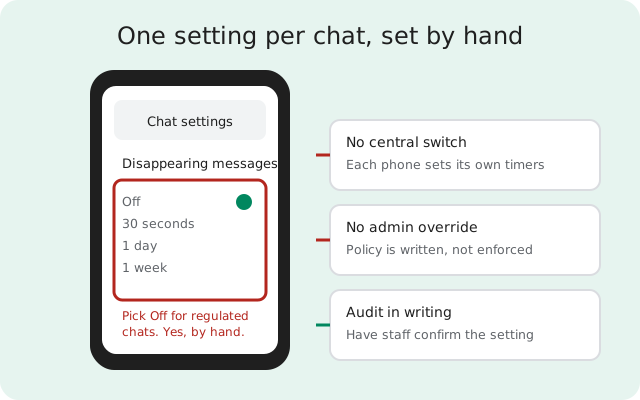
First, the timer is set by hand, per chat, by the people in it. There is no company-wide default, no policy push, no way to force every employee's chats to a given setting. If your plan depends on everyone having the right timer, your plan depends on everyone remembering - which is to say it is not a plan.
Second, deletion is best-effort, not guaranteed. A recipient can screenshot the chat, photograph the screen, or copy the text before the timer fires. Disappearing messages reduce how much old conversation sits on devices; they do not ensure anything is actually gone. Treat them as tidiness, never as destruction.
Third, and most important for this page: in a regulated setting, auto-deletion can be the wrong thing to do at all. If the law says keep, then a feature that deletes is not a convenience - it is a liability. Some teams hear "disappearing messages" and think "compliance-friendly privacy." The reality is closer to the reverse: for a team with retention duties, the compliant setting is usually timers off.
What record-keeping rules actually require
We cannot tell you what your duties are - that is the counsel conversation. But it helps to know what these duties generally look like, so you can recognize whether your team is in the zone where this page matters.
Retention duties usually come from three places. Regulators in industries like finance, securities, healthcare, and government contracting often require that business communications be preserved for a set period, sometimes years, and producible on request. Contracts can impose their own duties: a client agreement may say all project communications must be retained. And litigation creates its own duty: once a dispute is reasonably foreseeable, relevant messages must be preserved, and deleting them after that point can be treated as destroying evidence.
The pattern across all three is the same: someone other than the chat participants decides what must be kept, and the business must be able to produce it. Signal's architecture - messages on personal phones, no central archive, no admin access - cannot meet that pattern. A regulated team using Signal for the conversations themselves is building on a foundation that cannot hold the weight. The honest move is to keep those conversations in systems your retention policy actually covers: email, a compliant archiving platform, or whatever your counsel has approved.
This is also where our healthcare notes are worth reading if you are in that industry: they walk through why the same architecture that protects patients' privacy cannot produce the records a clinic may need.
What your team's policy should say
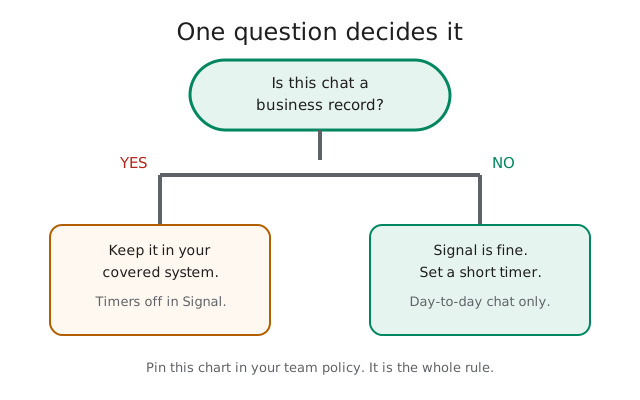
If your team has any retention duties at all, you need a written line between chat and record, and everyone needs to know which side they are on. Here is a practical way to draw it. It is not legal advice - it is a starting point to take to your counsel.
Rule one: regulated conversations do not happen in Signal. Client communications in a regulated industry, financial advice, anything your contracts say to retain, anything that might matter in a dispute - these live in your covered system, full stop. Signal can be the coordination around them ("the report is in your inbox, please review"), never the thing itself.
Rule two: timers off for anything near the line. For chats that are clearly casual - lunch plans, shift swaps, "on my way" - disappearing timers are fine. For anything where you hesitate, the timer stays off. Hesitation is the signal. When in doubt, keep.
| Conversation | Where it lives | Timer |
|---|---|---|
| Casual coordination, small talk | Signal | Short timer fine |
| Internal decisions, who agreed to what | Signal only if no duty applies; otherwise covered system | Off unless counsel says otherwise |
| Client messages in a regulated industry | Covered system, never Signal | Not applicable - not in Signal |
| Payment terms, agreements, commitments | Covered system, never Signal | Not applicable - not in Signal |
| Anything under a litigation hold | Preserved exactly as counsel directs | Off, and no deletions at all |
Rule three: say it in writing, and say it simply. A one-page policy beats a thirty-page one nobody reads. Name which conversations belong where, name the timer rule, name who to ask when unsure. The policy is your admin console - it is the only enforcement mechanism Signal gives you, so make it short enough to survive contact with a busy team.
Lines you must not cross: it can look like destroying evidence
This section is qualitative, and deliberately so. We are not your lawyers. But some patterns are widely understood to be dangerous, and a business page on this topic would be dishonest without naming them.
Turning on disappearing messages because trouble is coming
If a dispute, investigation, or audit is on the horizon and messages start vanishing, that timing will be noticed, and it will be read badly. Preservation duties can attach before anyone files anything - when litigation is reasonably foreseeable. Deleting after that point, by timer or by hand, can be treated as destroying evidence, with consequences that dwarf whatever the messages contained.
Using Signal to avoid creating records
Moving a conversation to Signal specifically so it will not be retained - choosing the app because it deletes - is the pattern regulators and courts look for. If the conversation would have been a record in email, having it disappear in Signal does not make it not-a-record. It makes it a missing record, which is worse.
Assuming deletion worked
Even outside any duty, remember the other side kept a copy until the timer fired, and may have kept it past that with a screenshot. Plans built on "the messages are gone" rest on a hope, not a guarantee.
The safe posture is boring: keep what you must keep, where you must keep it, and let Signal handle the chatter that nobody will ever need to produce. If you are unsure which category a conversation falls into, that is exactly the question to take to your counsel - before the timer runs, not after.
For the broader picture of running a team on Signal, our business overview covers the non-regulated side, and the usernames guide covers keeping client contact professional without exposing personal numbers.
Frequently asked questions
Is Signal compliant with message retention laws?
Signal itself cannot satisfy retention duties: it keeps no central archive and offers no retention controls. If your industry requires archiving business messages, those conversations must happen in a system your retention policy covers. This is general information, not legal advice.
Can we use disappearing messages and still comply with record-keeping rules?
Only for conversations that are not records. For anything your industry, contracts, or counsel say to keep, timers should be off and the conversation should live in your covered system. When in doubt, keep - and ask your counsel.
Does Signal offer an admin console for retention policies?
No. There is no admin console, no central retention setting, and no way to force timer settings on anyone's device. Each person sets their own timers, so enforcement is by written policy only.
Can a company be punished for employees using disappearing messages?
Deleting messages after a preservation duty attaches can be treated as destroying evidence, with serious consequences. Whether a duty attaches in your situation depends on your industry, contracts, and circumstances - talk to your counsel before setting timers.
Is this page legal advice?
No. It is general information about how Signal works. Retention duties vary by country, industry, and contract. If your business has any retention duties, talk to your counsel before deciding where conversations happen.
Keep reading
- the honest team guide for small businesses
- usernames for business without exposing numbers
- how disappearing messages really behave
- the healthcare compliance limits
- what Signal can hand over when asked