
Home / Privacy / Can police read Signal
Can police read your Signal messages? The honest answer
Published: October 7, 2026 · Updated: October 8, 2026
No, police cannot read your Signal message content, not with a warrant and not without one. Messages are encrypted on your device before they leave it, and Signal's servers never hold the keys, so there is nothing to hand over. But law enforcement can compel the tiny account record Signal keeps, and seizing your phone is a different question entirely.
from Signal's official site — file hosted by Signal, not by us
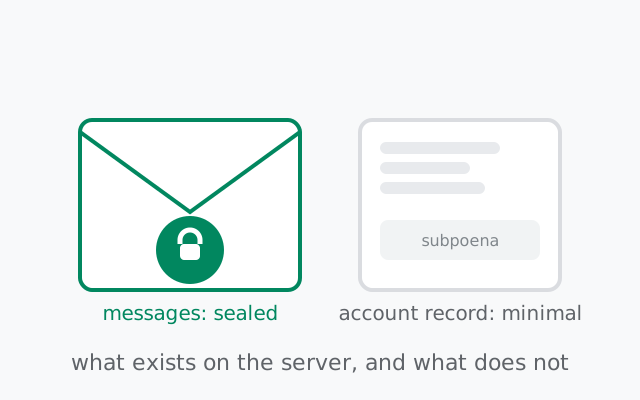
The short answer, precisely stated
Signal uses end-to-end encryption. When you send a message, your phone scrambles it with keys that live only on your device and the recipient's device. Signal's servers carry the scrambled envelope from one to the other and then delete it. The server never has the key, so no court order can produce the message content. This is not a policy choice Signal could reverse under pressure; it is a mathematical property of the design. To read your messages, police would need your unlocked phone or the recipient's, not Signal's cooperation.
That is the good news, and it is real. Now the rest of it.
What law enforcement CAN get from Signal
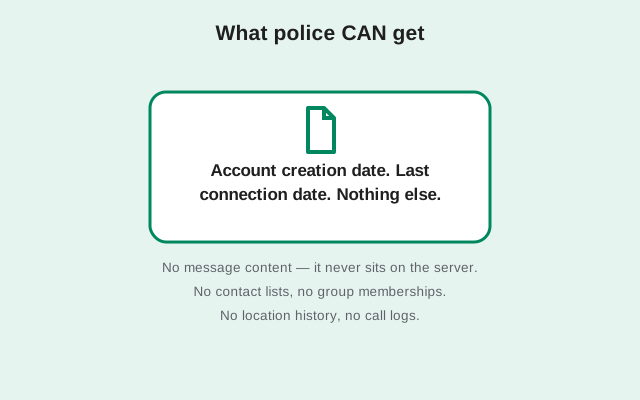
Signal publishes redacted copies of its responses to law-enforcement requests (subpoenas and court orders), so this is not speculation. For the legal mechanics behind those responses, see what a subpoena to Signal actually returns. When compelled, Signal hands over the account record, and the account record is tiny:
- Your phone number. Signal accounts are tied to a phone number (usernames now exist for contact, but the account identifier remains the number). That number is the account.
- When the account was created. A timestamp of registration.
- When it last connected. A timestamp of the most recent connection to Signal's servers.
That is the complete list. There is a reason it is so short: Signal designed its systems to store as little as possible, precisely so there is little to hand over. This is sometimes called data minimization, and it is the part of Signal's privacy story that matters as much as the encryption. A company cannot be compelled to produce data it does not have.
Note what is absent: no message content, no contact lists, no group memberships, no call logs, no location data, no profile contents beyond the basics needed to run the service. Compare that, quietly, with what a subpoena to most other messaging services returns.
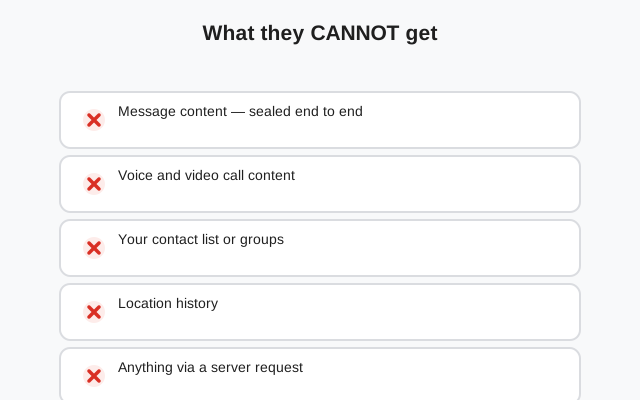
What they CANNOT get, ever
Worth stating explicitly, because rumors persist:
- Message content. Not past messages, not current ones, not with a warrant. The keys do not exist on Signal's servers.
- Real-time interception. There is no tap point. Because encryption happens on the devices, intercepting traffic between your phone and Signal's servers yields only scrambled data.
- Deleted messages. Messages live on the two endpoints, not on a server archive. Once deleted from both devices, they are gone from Signal's universe entirely.
- A master key or backdoor. None exists. Independent security audits have reviewed the code, and the design leaves nowhere to hide one.
Could a government compel Signal to push a malicious update that compromises users? This is the theoretical nightmare people raise. In practice it would require Signal to sabotage its own open-source, audited, reproducibly-built clients in a way visible to the entire security research community, destroying the company overnight. It is not a realistic attack path, and it is not how real investigations work.
What exists where: servers vs your phone
| Data | On Signal's servers | On your phone |
|---|---|---|
| Message content | No. Messages are queued briefly, then deleted | Yes. Your full chat history stays on your phone |
| Encryption keys | No | Yes |
| Phone number | Yes. It is the account identifier | Yes |
| Account creation date | Yes | Not stored |
| Last connection date | Yes | Not stored |
| Contacts list | No (contact matching uses hashed values, not stored lists) | Yes |
| Photos, files, voice notes | No | Yes |
The table makes the real risk obvious: your phone holds everything; the servers hold almost nothing. Every realistic law-enforcement scenario runs through the device, not through Signal the company.
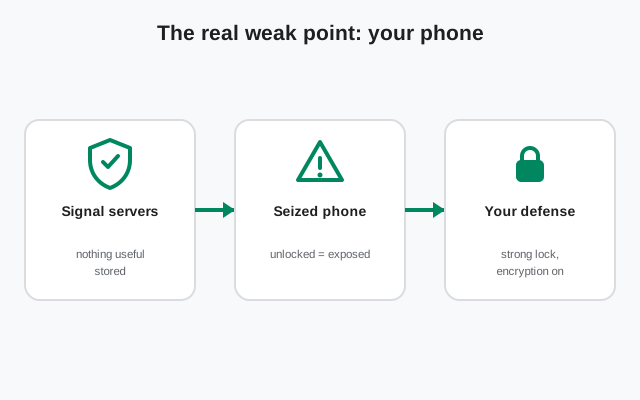
Your phone: the real weak point
This is the part the "can police read Signal" question usually misses. The encryption protects messages in transit and on the server. It does not protect messages on an unlocked phone in someone's hand:
- An unlocked, seized phone is an open book. If police have your phone unlocked, or compel you to unlock it (the law on this varies by country and is genuinely unsettled in many places), your Signal chats are readable. No cryptography is involved in opening the app on an unlocked device.
- Full-disk encryption helps only while locked. A locked phone with a strong passcode resists casual access. But legal compulsion to unlock, or sophisticated forensic tools against weak passcodes, are outside what any app can fix.
- The recipient's phone counts too. Your messages also live on every recipient's device. Your security is only as strong as the least careful person in the chat.
- Screenshots and screen recording. Disappearing messages help against casual snooping, but anyone can photograph a screen. Signal's screenshot blocking on Android raises the bar slightly; it does not make capture impossible.
This is not a Signal flaw. It is true of every messaging app ever made. The honest framing: Signal protects your messages from everyone except the people holding the devices at either end.
How real investigations actually play out
It helps to see how the pieces above combine in a realistic scenario, because the abstract version ("content is safe, devices are not") becomes concrete fast:
- Step one is almost always the device. Investigators who want message content go for phones: seized at arrest, taken with a search warrant, or unlocked through legal compulsion where the law allows it. Everything on the table in the previous section applies here.
- Step two is the service provider, for the account record. A subpoena to Signal returns the number, the creation date, and the last connection date. Investigators use this to confirm the account exists, to tie a number to activity windows, and to corroborate other evidence. It is thin, but in a case built on many small corroborations, thin counts.
- Step three is the people around you. Recipients, group members, anyone who screenshotted or forwarded. In practice, more "encrypted" conversations leak through a chat partner's carelessness than through any technical break.
- What almost never happens: breaking the encryption. There is no documented case of Signal's protocol encryption being defeated in the field. Attacks go around the cryptography (devices, humans, metadata) because going through it does not work.
The takeaway for an ordinary user: the investigation playbook has not changed because of encryption, and that is the point. Signal removes the easy central tap that used to exist with SMS and with weaker apps. What remains is the same police work as always: devices, warrants, witnesses. Plan your precautions around those, not around fantasies of unbreakable secrecy.
Killing the warrant-proof myth
You will see Signal described online as "warrant-proof" or "NSA-proof." Retire those phrases. They imply a magic shield, and magic shields invite careless behavior. The accurate description is narrower and stronger: Signal's servers hold no message content to surrender, so content warrants return nothing; your devices remain fully exposed to lawful search.
Two corollaries people get wrong:
- "They can't prove I use Signal." They can prove an account exists for your number and when it last connected. In some investigations, that alone is probative.
- "Deleting the app deletes the evidence." Deleting the app removes your local copy. It does nothing about the recipient's copy, backups you made, or screenshots anyone took.
Signal is the best tool available for keeping message content out of third parties' hands. It is not invisibility, and anyone selling it as invisibility is setting you up.
Practical steps that actually help
If this page has a threat model in mind, it is an ordinary person who wants their private conversations to stay private. The steps that matter, in order of impact:
- Lock your phone with a strong passcode. Not a 4-digit PIN, not a pattern. This is the single highest-impact step, because the device is the weak point.
- Enable disappearing messages for sensitive chats. They do not stop screenshots, but they shrink the window of exposure on lost or seized devices. Our disappearing messages guide covers the timers.
- Turn on registration lock. It prevents someone from re-registering your number on a new device. Find it in Signal's account settings.
- Keep the app updated. Security fixes ship in updates; running an old build forfeits them. If you install outside the Play Store, our APK update guide keeps you current.
- Think about the recipient. The most careful sender in the world is undone by a chat partner with an unlocked phone and a nosy roommate.
And the meta-step: match your tools to your actual threat model. For keeping messages away from companies, hackers, and dragnet surveillance, Signal is excellent. For resisting a targeted investigation with device seizure powers, no app is sufficient, and anyone who tells you otherwise is selling something.
Frequently asked questions
Can police read my Signal messages with a warrant?
No. Warrants compel companies to hand over data they hold, and Signal's servers hold no message content and no encryption keys. The published subpoena responses show the account record is all there is: number, creation date, last connection date.
Can police intercept Signal messages in real time?
No. Encryption happens on your device before anything is sent, so intercepted traffic is unreadable scrambled data. There is no server-side tap point that would yield content.
What happens if police seize my phone?
If the phone is unlocked or you are compelled to unlock it, your Signal chats are readable. The app opens normally on an unlocked device. This is true of every messaging app. A strong passcode and disappearing messages are your defenses here, not the encryption.
Can police see who I talk to on Signal?
Signal's servers do not store contact lists or conversation graphs in readable form. What exists is the minimal account record. Note that the recipient's device holds the other half of every conversation.
Does deleting Signal delete the evidence?
It deletes your local copy only. Recipients keep their copies, and any backups, screenshots, or photos of screens you or others made are unaffected.
Is Signal really warrant-proof?
No app is warrant-proof, and the phrase is misleading. The accurate claim: Signal's servers hold no content to surrender. Your devices remain subject to lawful search like everything else you own.
Keep reading
- what metadata Signal actually keeps: the tiny account record in detail
- is Signal really private? an honest review: the full privacy picture
- Signal's independent security audits: why there is no backdoor to find
- disappearing messages, explained: shrinking exposure on your device
from Signal's official site — file hosted by Signal, not by us