Why use a Signal fork? The honest version
Published: October 7, 2026 · Updated: October 8, 2026
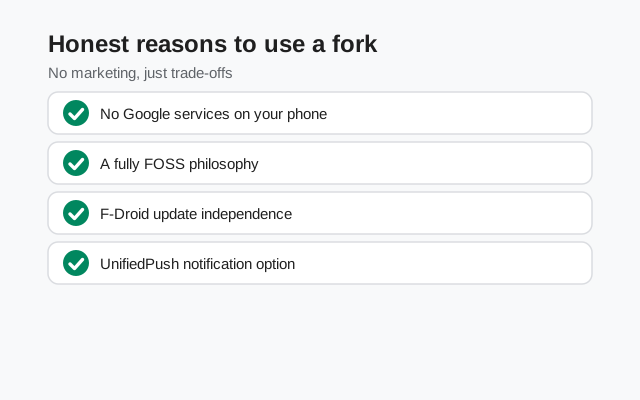
People use a Signal fork for a short list of real reasons: a phone without Google services, a principled stand against proprietary code, F-Droid-based updates, Google-free notifications, and a passphrase-locked local database. Those reasons are genuine, and for some people they are decisive. But the fork also costs you things: slower security updates, a smaller team, no official support. This page gives you both sides straight, then a decision framework so you can place yourself on it.
The honest reasons to use a fork
Let us start with what this page is not: it is not a sales pitch. Forks are not for everyone, and a page that pretends otherwise is marketing. What follows are the reasons people actually give, in their own terms, for running Molly instead of official Signal. Each one is real. None of them applies to everyone.
A note on scope: "a Signal fork" here means a genuine fork like Molly, with published code and its own releases. It does not mean random "Signal Plus" downloads, which are scams wearing a fork's name. If you have not read it, the forks and fakes guide draws that line first.
Reason 1: your phone has no Google services
This is the big one, the reason Molly exists. If your phone runs without Google services, a Huawei device after the trade restrictions, GrapheneOS, CalyxOS, a de-Googled custom ROM, official Signal's notification plumbing has a hole in it. Signal on a normal phone wakes up for incoming messages via Google's Firebase Cloud Messaging. No Google services means no FCM, which means notifications get unreliable.
Molly-FOSS was built for exactly this gap. It replaces Google push with UnifiedPush, an open push standard, or with a direct background connection that talks to no Google server at all. On a Google-free phone, the difference is not philosophical; it is the difference between messages arriving and messages not arriving. For these users the fork is not a preference, it is the practical answer, and everything else on this page is secondary.
If your phone has Google services and they work fine, this reason does not apply to you. Read that twice. The strongest argument for the fork is also the most situational one, and most readers can skip it honestly.
Reason 2: the FOSS philosophy
Some people run a fork on principle. Official Signal's client is open-source, but parts of the surrounding stack touch proprietary Google components. For someone who has de-Googled their phone as a statement, running a messenger that quietly depends on Google's push servers feels like a contradiction. Molly-FOSS resolves it: no proprietary bits, open standard push, the whole stack inspectable.
This is a values reason, not a convenience reason, and it should be stated as one. It does not make your messages more encrypted. The protocol and the end-to-end encryption are identical between Molly and Signal; the cryptography does not care about your philosophy. What the FOSS build buys is consistency: a phone with no proprietary code running a messenger with no proprietary code. If that consistency matters to you, it matters completely. If it does not, it buys you nothing.
Be honest with yourself about which camp you are in. Plenty of people admire the philosophy without wanting the maintenance burden that comes with it, and that is a fine position. Admiration is not an obligation.
Reason 3: F-Droid updates and independence
Molly ships through its own F-Droid repository, which appeals to people who have left the Play Store behind. If your phone has no Play Store, or you simply prefer F-Droid's model of verified open-source builds, getting your messenger the same way as the rest of your apps is cleaner than sideloading APKs by hand. One update channel, one trust decision, everything in one place.
There is a subtler independence argument too. Some users like that their messenger's updates do not flow through Google's store infrastructure at all. That is partly philosophy again, and partly practical: in regions or situations where the Play Store is unavailable or untrusted, an independent distribution channel is not a luxury. For most people with a working Play Store, this reason is weak. For the people it applies to, it is load-bearing.
Note the tradeoff hiding inside this reason: independence from the Play Store means dependence on the fork's own release pipeline, which is slower than Signal's. You are trading one dependency for another. Make sure the trade is worth it for your situation.
Reasons 4 and 5: UnifiedPush and the locked database
Two feature-level reasons round out the list. First, UnifiedPush notifications: on the FOSS build, push messages flow through an open standard instead of Google's servers. Beyond the de-Googled-phone case, some users simply prefer that no Google server sees their push metadata. It is a narrower reason than the phone one, but it is coherent: less Google in the loop, by design rather than by accident.
Second, the passphrase-locked local database. Molly lets you encrypt its on-device message database with a passphrase, so someone who gets hold of your unlocked phone does not automatically get your message history. Official Signal protects messages in transit and at the protocol level, but its local database is not passphrase-locked the same way. For most users this is a nice-to-have. For journalists, activists, or anyone whose phone might be seized or searched, it is a meaningful extra layer, and it is arguably the fork's best feature-level argument.
Both reasons share a shape: they matter enormously to a few people and barely at all to everyone else. That is the pattern of this entire page. The fork's case is a collection of sharp, specific reasons, not one broad one.
The honest reasons to stay with official Signal
Now the other side, given the same respect. These are not dismissals of the fork; they are the real costs, and for most people they outweigh the benefits.
- Faster security updates. Molly trails Signal's releases. Official Signal gets patches the day they ship; the fork gets them after the merge-build-test pipeline. If you install updates promptly because you care about security, the official app's pipeline is strictly better.
- A bigger security team. Signal Foundation is a funded nonprofit with full-time security engineers. Molly is a community project. Both publish code, but the resources watching that code are not comparable. This matters for a security-critical app.
- Official support. When something breaks in official Signal, there is a support operation and extensive official documentation. When something breaks in Molly, there is community documentation and forums. The difference shows up exactly when you are stressed.
- Simplicity. No repos to add, no distributors to configure, no battery-exemption archaeology, no release-lag watching. Install, verify, done. For most people, on a normal phone, this is the whole argument.
- The network is the same. Molly users and Signal users chat together. Same network, same protocol, no one loses contacts. Choosing official Signal costs you no contacts, no groups, no conversations. The fork's network effects are zero because there is no separate network.
Notice the last point deflates both sides' tribalism. Because the protocol and network are shared, the choice is only about the client. You are not joining a movement or abandoning one. You are picking an app.
The decision framework
| Your situation | The honest answer | Why |
|---|---|---|
| Phone has no Google services | Use Molly-FOSS | Notifications actually work; this is the fork's home turf |
| Phone seized or searched is a real risk | Consider Molly | Passphrase-locked database is a genuine extra layer |
| Zero proprietary code is a principle | Use Molly-FOSS | The only consistent choice for a de-Googled stack |
| No Play Store, F-Droid is your world | Consider Molly | Cleaner updates through the repo you already use |
| Normal phone, Google services work | Use official Signal | Same encryption, faster updates, support, simplicity |
| You want same-day security patches | Use official Signal | The fork's pipeline adds delay by design |
| You just like trying alternatives | Try Molly, keep a backup | Curiosity is fine; the backup makes it safe |
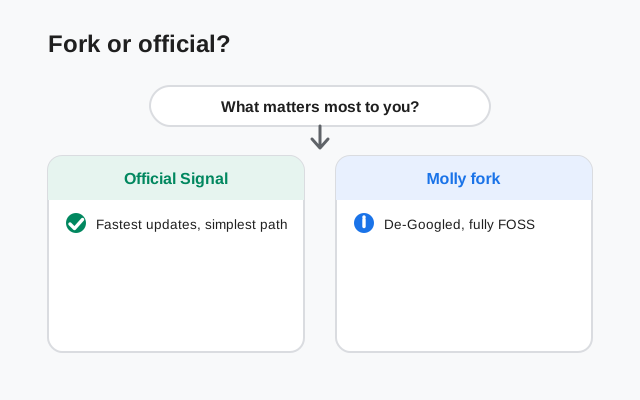
Find your row. If you are between rows, the tiebreaker is maintenance appetite: the fork asks more of you (repos, distributors, battery settings, release watching) and the official app asks almost nothing. Pick the one whose asking price you will actually pay, because a fork you do not maintain is worse than the official app you do.
The verdict, in one paragraph
Use a fork if you have a specific reason from the first half of this page, and use official Signal otherwise. The fork's reasons are real but narrow: Google-free phones, FOSS principle, F-Droid life, open push, a locked database. The official app's reasons are real and broad: speed, team, support, simplicity. Most readers should use official Signal and feel good about it; a minority genuinely needs Molly and should use it confidently. Either way, you are on the same network, talking to the same contacts, with the same encryption. The Molly vs Signal comparison has the feature-by-feature detail if you want to double-check your row.
from Signal's official site (file hosted by Signal, not by us)
Frequently asked questions
Is Molly more private than Signal?
Mostly no. The protocol and end-to-end encryption are identical. Molly's privacy edge is situational: no Google in the notification path on the FOSS build, and an optional passphrase-locked local database. For most users the difference is negligible.
Will my contacts know I use a fork?
No. Molly speaks the same Signal protocol on the same network, so chats, groups, and calls work across both apps invisibly. Your contacts cannot tell which client you use.
Is it risky to use a fork instead of official Signal?
The main risks are structural: security patches arrive later, the team is smaller, and there is no official support. Those are disclosed tradeoffs, not hidden dangers, and the decision framework above helps you weigh them.
Can I try Molly and switch back if I don't like it?
Yes. Back up in Molly, install official Signal, register your number, and restore with your recovery key. Your chats move with you in both directions.
Does using Molly support Signal Foundation?
Indirectly at most. Molly is an independent project, not affiliated with or funded by Signal Foundation. If supporting Signal's development matters to you, that is a point for the official app and its donation model.
Keep reading
- the Molly hub: every fork guide in one map
- what Molly is: the fork explained
- Molly vs Signal: the head-to-head differences
- which Molly build to pick: standard vs FOSS
- other forks and fakes: the wider landscape
- official Signal APK: for the majority who should stay official