
Signal vs Wire: Personal Privacy or Team Messaging?
Published: October 7, 2026
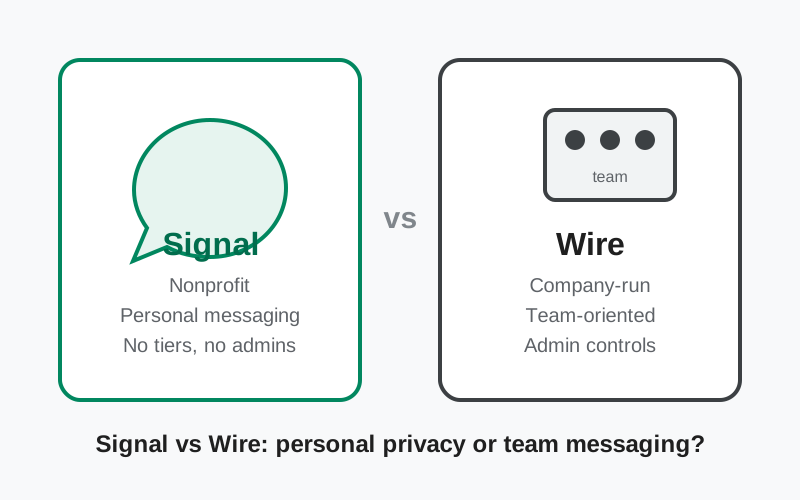
Most "Signal vs X" comparisons are popularity contests. This one is different, because Signal and Wire are not trying to win the same game. Signal wants to be the private messenger for everyone. Wire wants to be the secure messenger for teams, companies, and organizations that need someone in charge of the user list. Put them side by side and neither looks like a worse version of the other. They look like answers to different questions.
from Signal's official site — file hosted by Signal, not by us
The two apps, side by side
| Signal | Wire | |
| Built for | Personal messaging for everyone | Teams and organizations, plus a free personal tier |
| Owner | Signal Foundation, a US nonprofit | Wire, a private company |
| Business model | Donations and grants; no ads, no data business | Paid team and business plans fund the service |
| Cost to you | Free, no tiers, no upsells | Free for personal use; organizations pay for team plans |
| Chat encryption | End-to-end encrypted by default for every chat and call | End-to-end encrypted |
| Open source | Client app is open source (AGPLv3) | Clients are open source |
| Registration | Phone number required (usernames let you hide it from contacts) | Accounts built around personal or team identity |
| Admin controls | None. Nobody administers your contacts. | Team management and administrative controls for organizations |
| Network size | Large and growing personal network | Much smaller personal network; its strength is inside organizations |
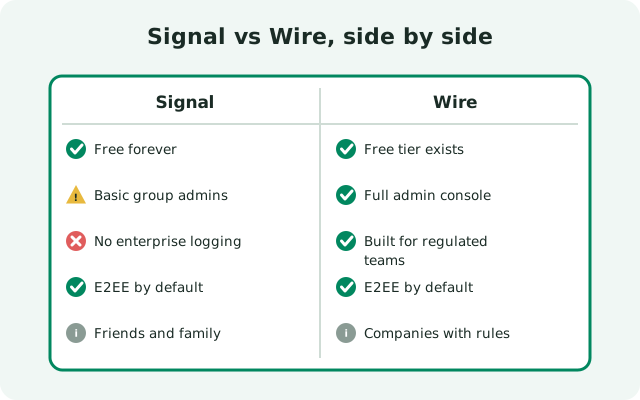
A table flattens real differences, so treat this as a map, not the territory. The rows that decide the question are the business model, the admin question, and what each app collects. Each deserves a closer look.
Where Wire is genuinely strong
Wire's best argument is not a feature list. It is a sentence: someone needs to be in charge. In a company, a clinic, or a newsroom, messaging cannot be a free-for-all of personal accounts. People join, people leave, and the organization needs to manage that. Wire is built for that reality, and Signal simply is not.
Team management that companies actually need
Wire lets an organization provision accounts, organize people into teams, and remove access when someone leaves. If you have ever watched a company try to run sensitive work over a consumer messenger, you know why this matters: without admin controls, offboarding is a hope, not a process.
A business model that fits business use
Companies are used to paying for tools, and paid plans come with the things companies expect: support, predictable service, and a vendor relationship. Signal's nonprofit, donation-funded model is admirable, but it offers no business tier, no support desk, and no service agreement. For a team choosing a tool, "free forever from a nonprofit" can feel less safe than a paid contract, even when the technology is excellent.
Secure without the consumer-messenger baggage
Wire encrypts end to end and publishes its client code, so a security-conscious organization gets real cryptography, not theater. For teams that cannot use a consumer app for policy reasons but still need genuine encryption, Wire sits in a useful middle ground.
None of this makes Wire the better personal messenger. It makes it the better organizational messenger, which is a different job.
Where Signal is genuinely stronger
Signal's advantages are structural. They come from what the organization chose not to build and not to collect.
A nonprofit with nothing to sell you. Signal Foundation has no advertisers, no data business, and no growth team. Wire is a company, and companies answer to their economics. That does not make Wire untrustworthy, but it does mean the incentives differ. When privacy is the product and there is nothing else to sell, privacy tends to win.
Free for everyone, no tiers, no upsells. Every Signal user gets the same app with the same protections. There is no premium tier holding features hostage and no sales process. Wire's free personal tier is real, but the company's attention naturally follows its paying team customers.
Minimal metadata by design. Signal is engineered to know almost nothing about who talks to whom: it stores your number, registration dates, and when you last connected, and not your contacts or your conversations. Its responses to government data requests have shown exactly that. A company-run service with team management inherently holds more administrative data about its users, because that is what admin tools are made of.
The personal network effect. For everyday chats, the best messenger is the one your people already use. Signal's personal user base is far larger than Wire's, so the odds that your friends and family are already there are much better. A team messenger with nobody to message is a quiet app.
The team question: admins, compliance, and cost
This is the section that decides the comparison for organizations, so let us be concrete. If you are choosing a messenger for a team, you are really answering three questions.
Who manages the users? On Wire, the organization does: accounts can be created, grouped, and deactivated centrally. On Signal, nobody does. Every account is personal, tied to a phone number, and entirely outside any admin's reach. For a company, that is a dealbreaker. For a family, it is a feature.
What does it cost, really? Signal costs nothing and asks for nothing, which is wonderful for personal use and awkward for procurement. Wire's paid plans cost money, which buys the support and accountability that IT departments require. "Free" is not always cheaper once you count the cost of running a tool with no vendor behind it.
What about compliance? Regulated industries need audit trails, data controls, and someone to call. A team-oriented product with admin tooling is built with those needs in mind. A consumer privacy app is built to minimize data, which is the opposite of what a compliance officer wants to hear. Neither approach is wrong; they serve different masters.
If none of those questions apply to you, you are not the team customer, and the rest of this comparison tilts toward Signal.
Privacy design: who holds what
Both apps encrypt message content end to end, so the honest comparison moves to what surrounds the messages. Signal's design goal is to have almost nothing to give away: minimal metadata, sealed sender hiding who messages whom from its own servers, and open-source clients anyone can inspect. Its nonprofit structure means there is no business reason to collect more.
Wire also encrypts content and opens its clients, which puts it well ahead of mainstream messengers. The difference is that team tooling needs administrative data to function: organizations, membership, roles. That is not a scandal; it is the price of the admin console. But it means Wire's privacy story is "we protect your content and run a tight ship," while Signal's is "we designed the ship to carry almost no cargo." For a journalist or activist, that distinction matters. For a company choosing a team tool, the admin data is the point.
Who should pick which
| Your situation | The honest pick |
|---|---|
| You want private chats with friends and family | Signal. Simpler, free, bigger personal network, minimal metadata. |
| You run a company or team and need user management | Wire. Admin controls, team plans, and business support Signal does not offer. |
| You need a vendor contract or support desk | Wire. Paid plans come with the accountability procurement expects. |
| You are a journalist, activist, or handle sensitive personal work | Signal. Nonprofit, minimal metadata, and open source is the safer combination. |
| You want one app for work and personal life | Probably Wire if work dominates, but many people sensibly run both: Wire for the team, Signal for life outside it. |
| You want the cheapest secure option for personal use | Signal. Free with no tiers is hard to beat. |
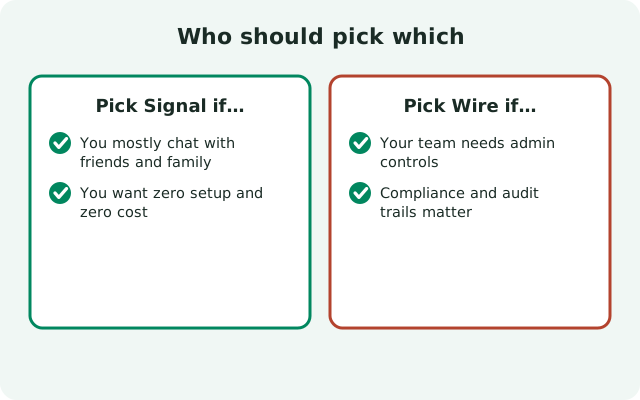
The pattern is simple: personal use points to Signal, organizational use points to Wire. The apps overlap in the middle, and running both is common and completely fine.
If Signal is your pick and your phone has no Play Store, grab the official build straight from Signal: our Signal APK download guide walks through verifying it. To see how Signal's two official builds differ, read the APK vs Play Store comparison.
Frequently asked questions
Is Wire end-to-end encrypted?
Yes. Wire encrypts messages end to end, and its clients are open source. It is a legitimate secure messenger, not just a business chat tool with a lock icon.
Is Wire free to use?
Wire has a free personal tier. Teams and organizations use paid plans, which is how the company funds the service. Signal, by contrast, is free for everyone with no paid tier at all.
Who owns Wire?
Wire is run by a private company. Signal is run by the nonprofit Signal Foundation. That difference in ownership shapes everything from pricing to data incentives.
Can I use Wire just for personal chats?
You can, and the free personal tier works for that. But its personal network is much smaller than Signal's, so you may struggle to find your contacts there.
Which is better for a company: Signal or Wire?
Wire, for most companies. It offers team management, administrative controls, and paid plans with business support. Signal has no admin console, no business tier, and no way for IT to manage users.
Can I run both Signal and Wire?
Yes. They are separate apps, and some people use Signal for personal chats and Wire for work. Nothing about either app prevents that.
Related guides
- All Signal comparisons: the full compare hub
- Signal vs Threema: paid vs free private messengers compared
- Best private messenger 2026: roundup with Signal among the top picks
- Signal vs Session: phone-number vs no-identifier messenger models