
Signal vs RCS: an Honest Comparison
Published: October 7, 2026 · Updated: October 8, 2026
RCS has been marketed as the upgrade that finally fixes texting. And in some ways it does: typing indicators, read receipts, big photo and video sharing, all inside the default messaging app on most Android phones. Google then added end-to-end encryption on top, and headlines declared the privacy problem solved. The reality is more complicated, and the complications all point the same direction: RCS encryption is conditional, and privacy that only works sometimes is not privacy you can rely on.
from Signal's official site — file hosted by Signal, not by us
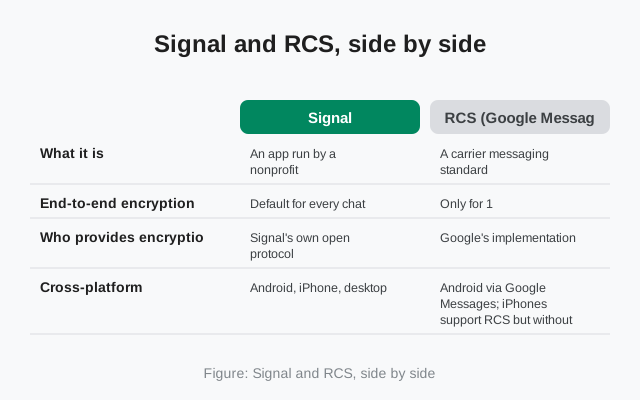
Signal and RCS, side by side
| Signal | RCS (Google Messages) | |
| What it is | An app run by a nonprofit | A carrier messaging standard, implemented by Google's Messages app on Android |
| End-to-end encryption | Default for every chat, group, and call | Only for 1:1 chats between Google Messages users; not for groups |
| Who provides encryption | Signal's own open protocol | Google's implementation, built on the Signal Protocol, closed on the server side |
| Cross-platform | Android, iPhone, desktop | Android via Google Messages; iPhones support RCS but without Google's encryption |
| Fallback | None: a Signal message is always encrypted | Falls back to SMS/MMS, which have no encryption at all |
| Carrier dependence | None: works over any internet connection | Depends on carrier and region support |
| Metadata | Minimal by design | Google account and usage data under Google's privacy policy |
| Verification | Open source; safety numbers you can check | Closed; you trust Google's implementation |
The table's most important row is the fallback row. Everything else is a detail; the fallback is the structural flaw.
What RCS actually is
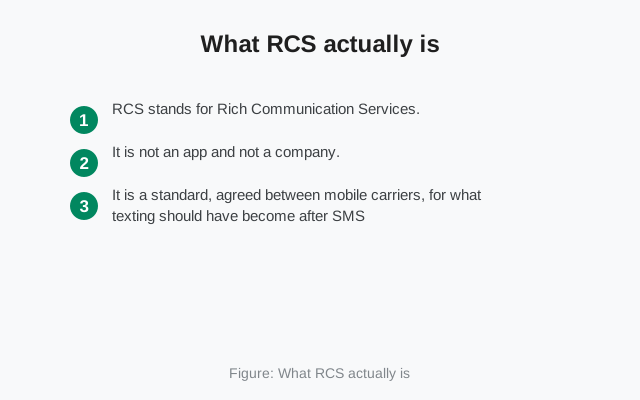
RCS stands for Rich Communication Services. It is not an app and not a company. It is a standard, agreed between mobile carriers, for what texting should have become after SMS: modern messaging with all the features people expect. Google took that standard, built it into its Messages app, and pushed carriers to support it, which is why most Android phones today do RCS out of the box.
This history matters because it explains every limitation below. RCS was designed by carriers, for carriers, in a world where encryption was an afterthought. Google bolted end-to-end encryption onto its own implementation afterward. That is genuinely better than nothing, and Google deserves credit for doing it. But a bolted-on feature inside a carrier standard will never have the guarantees of a system designed around encryption from the start.
It also matters because "RCS" means different things on different phones. Google Messages on Android does Google's version. Samsung's app does its own thing in some regions. iPhones now speak RCS too, but Apple's implementation and Google's implementation do not share Google's encryption layer. When someone says "RCS is encrypted," always ask: which RCS, between which apps, in which chat?
The encryption gap: where RCS protection stops
Google's end-to-end encryption for RCS uses the Signal Protocol, the same cryptography family Signal itself uses. That is a serious, well-regarded foundation. The problem is not the math. The problem is the coverage.
One-to-one only
Google's RCS encryption applies to direct conversations between two people. Group chats are excluded. In a group RCS chat, Google and the carriers handle your messages without end-to-end protection. Given how much of real life happens in groups, family groups, friend groups, work groups, this is a large hole, not a small one.
Google Messages to Google Messages only
The encryption is Google's proprietary layer on top of RCS. It works when both people use Google Messages. Chat with someone on a different RCS app, or with an iPhone, and the encryption does not apply. There is no interoperable standard here: Google's encryption is a Google feature, not an RCS feature. Our Signal vs iMessage comparison covers the iPhone side of this gap.
Carrier and region dependent
RCS itself needs carrier support to work at all, and that support is uneven around the world. Where RCS is not supported, or where it glitches, the conversation drops to SMS. Which brings us to the real problem.
You cannot verify it
Google's implementation is closed. There are no safety numbers to check, no open code to audit, no way for you to confirm that the person you are talking to is really who the app says they are. You are trusting Google, the carrier, and the whole chain in between. Compare that with how Signal's encryption works, where verification is a built-in ritual, not a leap of faith.
The SMS fallback problem
Here is the scenario that breaks every "RCS is encrypted" claim: you are chatting with someone, the RCS connection drops, and your app silently sends the next messages as SMS. SMS has no encryption. None. Your messages travel as plain text through carrier systems, readable by the carrier, interceptable over the air with the right equipment, and stored God-knows-where.
This is not a rare edge case. It happens when the other person loses data coverage, when RCS provisioning glitches (which it does, regularly), when you message someone whose carrier never enabled RCS, and when you roam onto networks that do not support it. Each time, the app is supposed to warn you. Warnings are small, easy to miss, and easy to tap through. Most people have no idea which of their "text messages" went out encrypted and which went out naked.
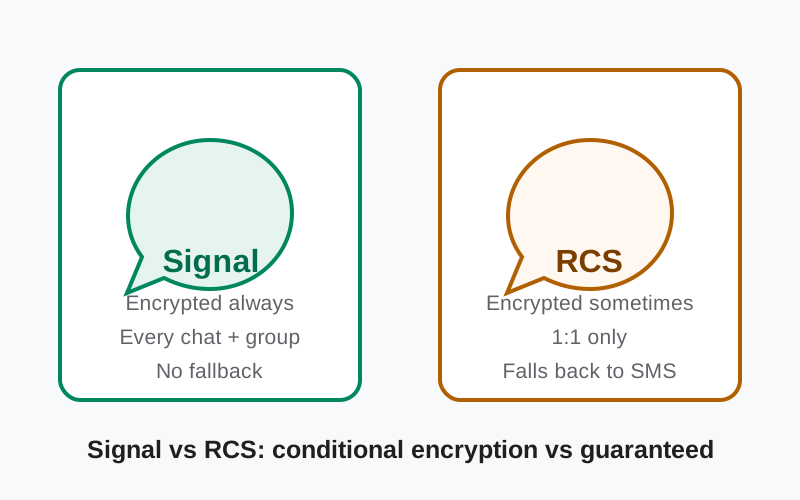
Signal has no fallback because Signal has nothing to fall back to. A Signal message either goes through encrypted or it does not go. That all-or-nothing design is the entire point. Conditional privacy, privacy that quietly downgrades itself when conditions change, trains users to assume protection they do not have. The green "RCS" label in your messaging app does not tell you whether this particular message, to this particular person, right now, is actually encrypted. And that uncertainty is the vulnerability.
Why "RCS is encrypted now" does not replace Signal
Partial encryption vs total encryption
Put the pieces together and the picture is clear. RCS encryption is real but partial: 1:1 only, Google Messages only, carrier-dependent, unverifiable, and one glitch away from SMS. Signal's encryption is total: every chat, every group, every call, every platform, verifiable, with no fallback to anything weaker.
Who you are trusting
There is also the question of who you are trusting. Google is an advertising company. Its RCS encryption protects message content from outsiders, which is good. But your messaging metadata, who you talk to, when, how often, lives inside Google's systems under Google's privacy policy. It feeds the same profile Google builds from your search, your location, and your email. Signal's nonprofit structure means there is no profile to feed. Our Signal metadata guide explains exactly how little Signal keeps.
RCS is still a genuine upgrade over SMS
None of this means RCS is useless. For ordinary texting with people who will never install another app, RCS is a genuine upgrade over SMS: better media, better group handling, and encryption in the best case instead of never. Use it and enjoy it. Just do not confuse "better than SMS" with "a private messenger." The distance between those two is the distance between this page's two columns.
Be honest about the threat model
And be honest about the threat model. If your concern is a nosy carrier or a thief with a radio scanner, RCS encryption in the best case helps. If your concern is a government request, a compromised carrier, or Google's own data collection, only the best case helps, and you will rarely know whether you are in it. Signal removes the question entirely.
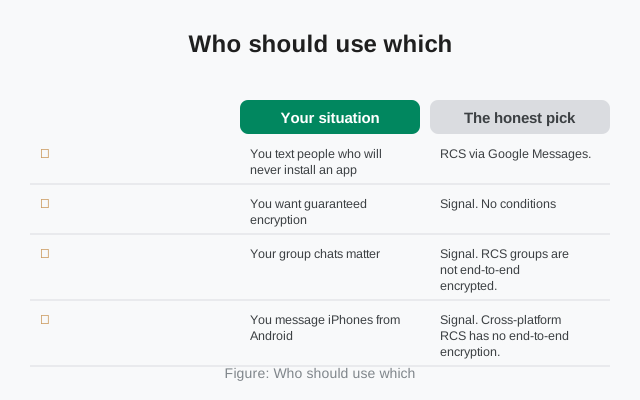
Who should use which
| Your situation | The honest pick |
|---|---|
| You text people who will never install an app | RCS via Google Messages. It is the best the default texting experience gets. |
| You want encryption by default on every message | Signal. No conditions, no fallback, no guessing. |
| Your group chats matter | Signal. RCS groups are not end-to-end encrypted. |
| You message iPhones from Android | Signal. Cross-platform RCS has no end-to-end encryption. |
| You want privacy from Google itself | Signal. Nonprofit, minimal metadata, no ad business. |
| You just want better texting with zero effort | RCS. It is already on your phone; turn it on and enjoy the upgrade over SMS. |
| You handle sensitive conversations | Signal. Verifiable encryption beats conditional encryption. |
The two are not enemies. Plenty of people use RCS for everyday texting and Signal for conversations that matter. What you should not do is look at the little lock icon in Google Messages and conclude the privacy problem is solved. It is improved. Solved is a different word.
If Signal is your pick and the Play Store is not on your phone, grab the verified build straight from the source: our Signal APK download guide walks through it, and the current website build is version 8.29.3.
Frequently asked questions
Is RCS end-to-end encrypted?
Sometimes. Google's Messages app encrypts one-to-one RCS chats between Google Messages users. Group chats are not encrypted, chats with iPhones or other RCS apps are not covered, and conversations can silently fall back to unencrypted SMS.
Is RCS as private as Signal?
No. Signal encrypts every chat, group, and call by default with no fallback. RCS encryption is conditional on the chat type, the apps involved, and carrier support, and its implementation is closed.
Are RCS group chats encrypted?
No. Google's end-to-end encryption for RCS applies only to one-to-one conversations. Group RCS chats do not have end-to-end protection.
Is RCS between Android and iPhone encrypted?
Not end to end. Google's RCS encryption only works between Google Messages users. Cross-platform RCS chats do not get that layer of protection.
What happens when RCS fails?
Messages typically fall back to SMS or MMS, which have no encryption at all. Your texts then travel as plain text through carrier systems.
Should I still use RCS?
Yes, as an upgrade over SMS for everyday texting. Just do not treat it as a private messenger. Use Signal for conversations where privacy actually matters.
Related guides
- All Signal comparisons: the full compare hub
- Signal vs iMessage: the iPhone side of the RCS gap
- Signal vs WhatsApp: our in-depth WhatsApp comparison
- How Signal encryption works: verifiable encryption explained
- Signal metadata guide: how little Signal keeps