
Signal vs Element: Centralized Simplicity or Federated Control?
Published: October 7, 2026 · Updated: October 8, 2026
First, a clarification that most comparisons skip: Element is an app, and Matrix is the network it runs on. Matrix is an open, federated protocol, which means many independent servers talk to each other, like email. Element is the flagship app for that network. So "Signal vs Element" is really "one well-run centralized service vs a federation of servers you can choose between or run yourself." That one architectural difference explains nearly everything else on this page.
from Signal's official site — file hosted by Signal, not by us
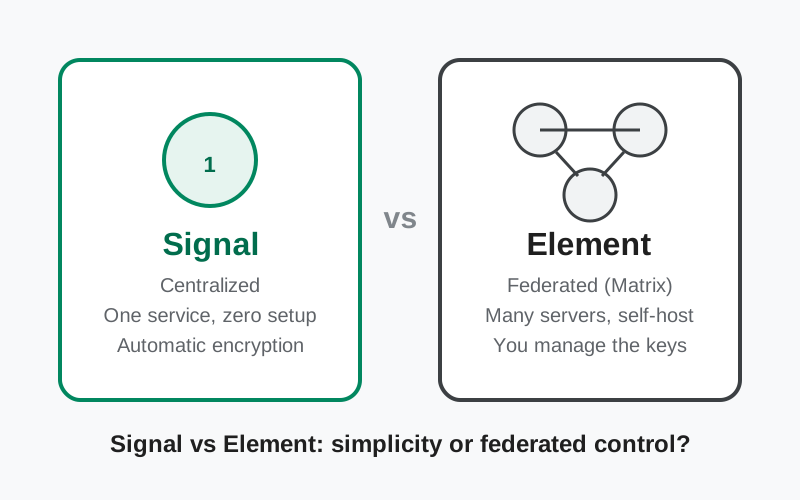
The two options, side by side
| Signal | Element (Matrix) | |
|---|---|---|
| Architecture | Centralized: one service run by Signal Foundation | Federated: many independent servers using the open Matrix protocol |
| Who runs the network | One nonprofit | Anyone: public servers, companies, or yourself |
| Encryption | End-to-end encrypted by default, everything, no setup | End-to-end encryption supported; device verification and key management are part of the experience |
| Openness | Client app open source (GPLv3) | Open protocol with many clients; run your own server |
| Registration | Phone number required | Account on whichever server you choose |
| Self-hosting | Not possible | Yes: run your own Matrix server |
| Bridges to other networks | No | Yes: bridges can connect Matrix rooms to other chat networks |
| Network size | Large personal network | Smaller, fragmented across servers |
| Cost | Free | App is free; paid hosting options exist for servers |
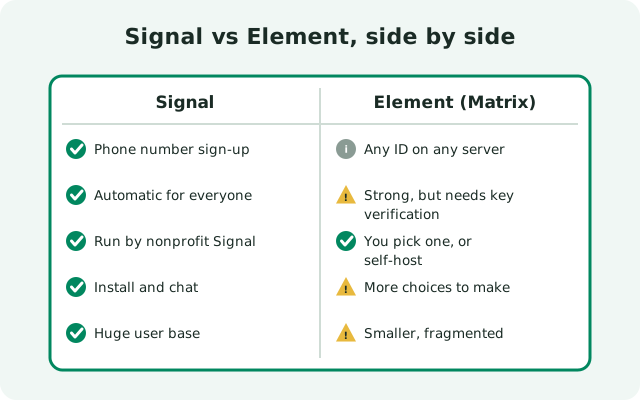
The table makes federation sound like a pure upgrade. It is not. Every row where Element offers more control is a row where Element asks more of you. That trade is the whole comparison.
What federation actually means for you
Federation is easiest to understand through email. Nobody "runs email." You pick a provider, or run your own server, and everyone can still message everyone. Matrix works the same way for chat: your account lives on one server, your friend's lives on another, and the servers relay messages between them. No single company can change the rules for the whole network, shut it down, or read everyone's metadata from one vantage point.
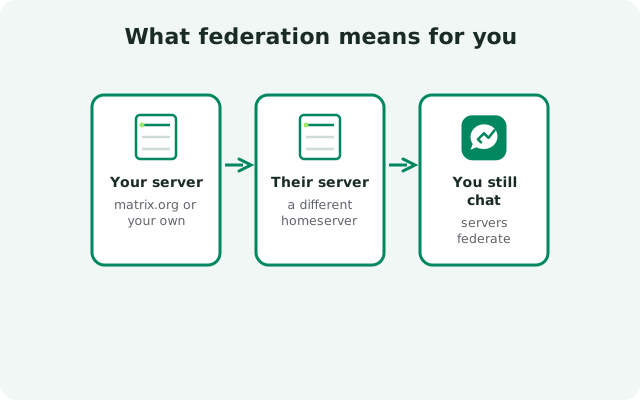
Signal is the opposite: one service, one set of servers, one organization making the decisions. That sounds like a weakness until you notice what it buys. There is no server to choose, no federation politics, no wondering whether your friend's server is well run. You install the app, verify your number, and everything works, encrypted, with people you already know.
So the real question is not "which is better" but "who do you want to trust?" With Signal, you trust one nonprofit with a strong track record. With Element, you trust whichever server you picked, plus the protocol's design, plus yourself if you self-host. Federation spreads trust around. Centralization concentrates it in one place that has earned it.
Where Element is genuinely strong
No single point of organizational control. This is the big one. If Signal Foundation ever changed direction, was acquired, or was pressured, every Signal user would feel it at once. Matrix has no such center. Servers come and go; the network continues. For people whose threat model includes the service operator itself, that structural property matters more than any feature list.
Self-hosting is real. You can run your own Matrix server for your family, your organization, or just yourself, and still talk to the rest of the network. Your messages never need to touch anyone else's infrastructure. Nothing in Signal's world offers that, because Signal's world is one service.
An open protocol with many clients. Matrix is a published standard, and Element is only one app that speaks it. If you dislike Element, other clients exist. If the protocol needs something, the community can build it. Open standards outlive companies, and that durability is a genuine advantage.
Bridges. Matrix bridges can connect rooms to other chat networks, so one app can reach people who live elsewhere. It is not seamless, and bridges have their own security trade-offs, but for consolidating many conversations it is something Signal will never offer.
Element's strengths are all about control and independence. If those words excite you, keep reading. If they sound like homework, Signal is calling.
Where Signal is genuinely stronger
It just works, for everyone. Signal's onboarding is: install, verify your number, done. No server choice, no homeserver names, no wondering what a homeserver is. Your non-technical family members can use Signal. Ask them to pick a Matrix server and watch what happens. Simplicity is a security feature too: the encrypted messenger people actually use beats the perfect one they never set up.
Encryption with no management burden. On Signal, every chat and call is end-to-end encrypted by default and key management is invisible. On Matrix, encryption is powerful but visible: new devices to verify, keys to manage, warnings to understand. That visibility is honest, but it is also friction, and friction is where most people give up.
One well-run service. Centralization has an upside nobody talks about: consistency. Signal's servers are run by one competent team with one security posture. In a federation, your privacy is only as good as your server's administration, and servers vary wildly. A badly run Matrix server can be worse for you than Signal's well-run one, and most users cannot tell the difference.
Minimal metadata by design. Signal is engineered to hold almost nothing about who talks to whom. Matrix servers, by the nature of federation, relay and store more protocol metadata as messages move between servers. Self-hosting solves this for your own traffic, but only for your own traffic.
The network is where your people are. Signal's personal network dwarfs Matrix's. For everyday messaging, that decides more than architecture ever will.
Encryption: automatic vs managed
This deserves its own section because it is where users actually feel the difference. Signal's philosophy is that encryption should be invisible: it is on, always, for everything, and you never think about keys. Safety numbers exist for the rare moments you want to verify a contact, but daily use requires zero cryptographic awareness.
Matrix's philosophy is that encryption should be visible and verifiable: you see device lists, you verify keys, you understand what is protected. For security professionals this transparency is a feature. For everyone else it is a series of alarming warnings about unverified devices. Both philosophies are defensible. Only one of them survives contact with your parents.
The honest summary: Signal gives you excellent encryption you never manage. Element gives you excellent encryption you partly manage, in exchange for independence from any single operator. Choose based on which side of that trade you live on.
Who should pick which
| Your situation | The honest pick |
|---|---|
| You want private messaging with minimal fuss | Signal. Install and go; encryption is automatic. |
| You want to run your own server | Element (Matrix). Self-hosting is the whole point, and Signal cannot do it. |
| Your threat model includes the service operator | Element on your own or a trusted server. Federation means no single company sees everything. |
| You are setting up messaging for non-technical family | Signal. No contest. Server choice is a support ticket waiting to happen. |
| You want one app for many networks via bridges | Element. Bridges are a Matrix-native idea. |
| You want the biggest private-messenger network | Signal. More of your contacts are already there. |
| You are a tinkerer who likes open protocols | Element. You will enjoy it, and the network needs people like you. |
Notice the pattern: everyday private messaging points to Signal; infrastructure independence points to Element. They are not really competitors. They are different answers to "who should run messaging?"
If Signal is your pick and your phone has no Play Store, get the official build from Signal itself: our Signal APK download guide shows how to verify it. Curious about Signal's open-source fork for de-Googled phones? Read Signal vs Molly.
Frequently asked questions
What is the difference between Element and Matrix?
Matrix is the open, federated messaging protocol; Element is the most popular app built on it. Comparing Signal vs Element is really comparing Signal's one-company service with the Matrix network that Element connects to.
Is Element end-to-end encrypted?
Matrix supports end-to-end encryption, and Element uses it for private conversations. You will deal with device verification and key management more than on Signal, where encryption simply works with no setup.
Can I run my own Matrix server?
Yes. That is the core idea of federation: anyone can run a server, and servers talk to each other. Signal offers no self-hosting option; you use Signal's service or you do not use Signal.
Is Element harder to use than Signal?
For basic chatting, no. But the full Element experience involves choosing a server, verifying devices, and managing encryption keys, which is more to learn than Signal's install-and-go setup.
Which is more private: Signal or Element?
It depends on your threat model. Signal minimizes metadata by design on one well-run service. Element lets you avoid trusting any single company by running your own server, but a poorly run server can be worse than Signal's.
Can I use Signal and Element together?
Yes, they are independent apps. Some people use Signal for everyday contacts and Element for communities or self-hosted setups. Matrix bridges can even connect some rooms to other networks.
Related guides
- All Signal comparisons: the full compare hub
- Signal vs Session: another decentralized messenger, compared
- Signal vs Molly: the independent open-source fork of Signal
- Best private messenger 2026: roundup with Signal among the top picks