
Signal vs Briar: an Honest Comparison
Published: October 7, 2026 · Updated: October 8, 2026
Most messenger comparisons are about companies: who owns the app, what data they collect. This one is about architecture. Signal trusts its own servers as little as possible but still uses them. Briar trusts no servers at all, because there are none. Understanding that single difference explains every tradeoff below, and it is the most interesting comparison on this site for anyone who wants to understand how private messaging actually works.
from Signal's official site — file hosted by Signal, not by us
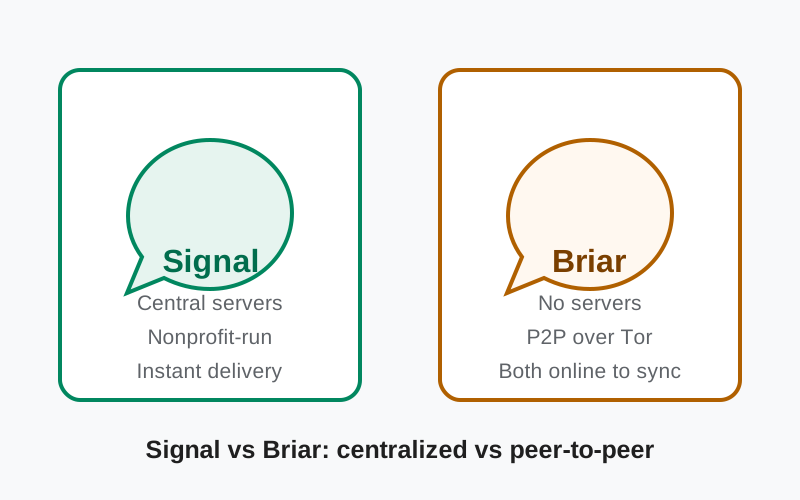
The two apps, side by side
| Signal | Briar | |
|---|---|---|
| Architecture | Centralized: messages pass through Signal's servers | Peer-to-peer: messages go directly between devices over Tor; no servers |
| Who runs it | Signal Foundation, a US nonprofit | An independent open-source project; no company, no servers to run |
| Encryption | Signal Protocol, end to end, by default | End-to-end encrypted, routed over Tor for metadata protection |
| Metadata exposure | Minimal: Signal designs servers to see almost nothing | Near-zero by architecture: with no servers, there is nothing to seize or subpoena |
| Open source | Client open source; server code published | Fully open source |
| Platforms | Android, iPhone, desktop | Android (no iPhone app) |
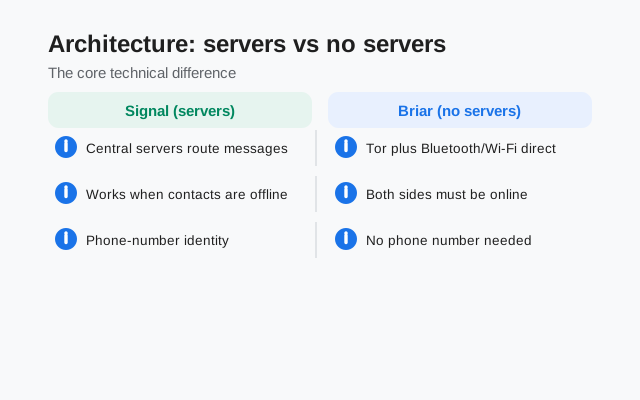
| Delivery | Instant, even if the recipient is offline | Both contacts must be online at the same time for messages to arrive |
| Battery use | Normal | Higher: maintaining Tor connections and syncing costs power |
| Network size | Large and growing | Small and niche |
| Ease of use | Feels like a normal messaging app | Demanding: slower, manual contact adding, always-online expectations |
Read the delivery row twice. It is the price of having no servers, and it shapes everything about using Briar.
Two architectures: servers vs no servers
Signal: servers designed to know almost nothing
Signal's design is a careful compromise. Messages travel through Signal's servers, which is what makes delivery instant and reliable: you can message someone whose phone is off, and it waits for them. But Signal's engineers treat those servers as hostile. Sealed Sender hides who is messaging whom from the servers themselves. The servers store almost nothing, which is why government data requests have historically returned nearly empty records. It is centralized infrastructure with decentralized trust: the servers do the work, but they are designed to be unable to abuse it.
Briar: no servers at all
Briar removes the compromise by removing the servers. When you message someone on Briar, your phone connects to their phone directly, over the Tor network, with end-to-end encryption. There is no company server that could be hacked, subpoenaed, pressured, or shut down, because there is no company server. The project's own description is peer-to-peer messaging over Tor with no central server, and it means exactly what it says.
Two defenses for two different adversaries
Why does this matter? Think about who you are defending against. Against criminals and snoopers, both designs are strong. Against a powerful adversary, a government that can lean on companies, seize servers, or block centralized services, the difference becomes real. Signal's defense is legal and technical minimalism: there is little to seize and the organization fights requests. Briar's defense is absence: there is nothing to seize at all. Our Signal threat-model guide explains how to think about which adversaries you actually face.
It is worth asking why Signal keeps servers at all, given Briar shows messaging can work without them. The answer is reliability for ordinary people. Servers let messages wait for offline recipients, sync across your phone and desktop, and arrive in milliseconds. Signal's bet is that servers designed to know almost nothing are good enough for nearly every threat model, and that the convenience they buy is what gets hundreds of millions of people onto encrypted messaging in the first place. Briar's bet is the opposite: for its target users, convenience is negotiable and architecture is not.
Tor adds a second layer to Briar's design. Even the fact that two people are communicating is hidden inside Tor's routing, which protects the metadata of the conversation, not just its content. Signal protects content strongly and metadata carefully; Briar's architecture protects both by never centralizing either.
Usability tradeoffs, honestly
Here is where Briar pays for its architecture, and the price is steep for everyday use:
- Both people must be online. With no server to hold messages, a Briar message can only be delivered when both phones are on and connected. Message someone who turns their phone off at night and your message waits until morning, not on a server, but unsent on your own phone. For people used to instant delivery, this feels broken. It is not broken; it is the design. But it feels broken.
- Battery and bandwidth. Keeping Tor connections alive and syncing directly with contacts costs power and data. Briar is noticeably heavier on battery than Signal. On old phones or expensive data plans, this is a real burden.
- Android only. Briar has no iPhone app, and building one for its architecture is genuinely hard. If your contacts use iPhones, Briar is not an option for talking to them. Signal, by contrast, works on Android, iPhone, and desktop.
- Adding contacts is manual. There is no phone-number discovery like Signal's. You add contacts by exchanging links or scanning codes in person or through another channel. This is good for security and bad for convenience.
- Speed. Tor routing adds latency. Messages arrive slower than Signal's near-instant delivery. Voice and video calling as most people know it is not really the point of Briar.
- Network size. Briar's user base is tiny compared to Signal's. A secure messenger with nobody to talk to is a research project, not a tool.
None of these are flaws in Briar's engineering. They are the honest cost of serverless messaging with current technology. The Briar developers chose their tradeoffs deliberately, for users who need them. But "deliberate" and "convenient" are different words.
Signal's usability, by contrast, is its superpower. It feels like any normal messaging app: install, verify your number, message anyone, instant delivery, calls, groups, stories, desktop sync. All of that convenience is subsidized by the servers Briar refuses to have. For a privacy tool, being easy is a security feature in itself: the private messenger people actually use beats the perfect one they abandon. If you want the decentralized comparison with a more everyday feel, our Signal vs Session comparison covers another serverless-leaning design.
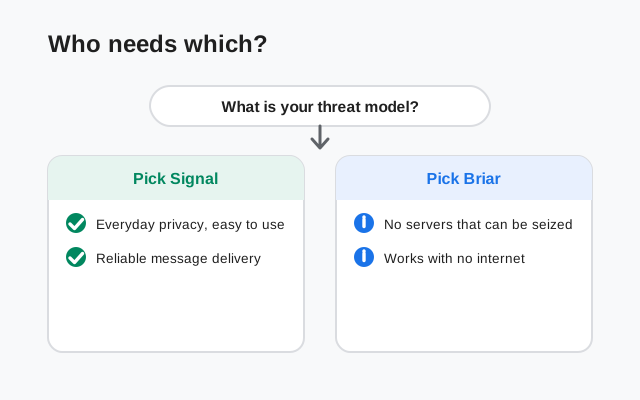
Threat-model fit: who needs which
"Threat model" sounds technical, but it is a simple question: who are you worried about? The answer decides this comparison.
Most people
Are worried about criminals, scammers, nosy acquaintances, data brokers, and companies monetizing their conversations. For all of these, Signal is not just sufficient, it is excellent. Its encryption is best-in-class, its metadata collection is minimal, and its nonprofit structure means nobody is building a profile on you. You give up nothing meaningful by choosing Signal over Briar for these threats, and you gain enormous convenience.
Journalists, activists, and dissidents in hostile environments
Face a different adversary: one that can pressure companies, seize infrastructure, block centralized services, and monitor networks at scale. Here Briar's architecture earns its keep. No servers means no server seizures, no company to pressure, no central point to block. Messages over Tor resist network-level surveillance in ways centralized designs cannot fully match. For this threat model, Briar's usability costs are not costs; they are the entry fee for the protection level required.
Between those extremes
Be honest with yourself. Most people who find Briar fascinating, and it is fascinating, do not face adversaries that require it. Running Briar as a daily messenger when your actual threats are marketers and thieves is like wearing a diving suit in the rain: impressive, uncomfortable, and unnecessary. Our encryption explainer shows how far Signal's protection already goes.
Operational security matters more than app choice
One more consideration: operational security matters more than app choice. The most secure messenger in the world does not help if your phone itself is compromised, if you discuss sensitive matters next to a smart speaker, or if your contact screenshots everything. Briar users tend to know this; Signal users should too.
Who should pick which
| Your situation | The honest pick |
|---|---|
| Everyday private messaging | Signal. Excellent privacy with normal-app convenience. |
| You face state-level surveillance or infrastructure seizure | Briar. No servers means nothing to seize or block. |
| Your contacts use iPhones | Signal. Briar has no iPhone app. |
| You need reliable offline delivery | Signal. Briar requires both parties online. |
| Internet shutdowns or censorship are likely | Briar has the edge: it can also sync over local networks without internet, by design. |
| Battery life and old phones matter | Signal. Briar's Tor connections cost power. |
| You want to understand privacy architecture deeply | Study both. They are the two cleanest examples of the centralization tradeoff. |
The verdict is deliberately lopsided: Signal for almost everyone, Briar for the few whose adversaries justify it. That is not a dismissal of Briar. It is respect for what it is: a specialized tool that refuses to compromise its architecture for convenience, built for people who cannot afford compromise.
If Signal is your pick and your Android phone lacks the Play Store, our Signal APK download guide walks through getting the verified website build (currently version 8.29.3) straight from Signal.
Frequently asked questions
What is Briar?
Briar is an open-source, peer-to-peer messenger with no central servers. Messages travel directly between phones over the Tor network, encrypted end to end. It is designed for people who need communication that cannot be shut down by seizing servers.
Is Briar more private than Signal?
Architecturally, Briar exposes less: with no servers, there is nothing to seize or subpoena, and Tor hides communication metadata. For most people's actual threats, Signal's privacy is already excellent and far more usable.
Why does Briar need both contacts online?
Because there is no server to store messages. Your phone can only deliver a message by connecting directly to the recipient's phone, so both must be on and connected at the same time.
Does Briar work on iPhone?
No. Briar has no iPhone app. It runs on Android phones and on desktop (Windows, macOS, and Linux). Its peer-to-peer-over-Tor architecture is difficult to build within iOS restrictions, so iPhone users cannot use it.
Is Briar hard on battery?
Yes, relatively. Maintaining Tor connections and syncing directly with contacts uses more power and data than a centralized messenger like Signal.
Should I use Briar instead of Signal?
For everyday messaging, no: Signal gives you excellent privacy with normal convenience. Choose Briar if your threat model includes state-level adversaries, infrastructure seizure, or network shutdowns.
Related guides
- All Signal comparisons: the full compare hub
- Signal vs Session: another decentralized design compared
- Signal threat-model guide: figuring out who you defend against
- How Signal encryption works: the protocol both designs respect
- Signal APK download guide: getting the verified build